You Still Read Every One
"Automated" usually means the machine types it and you check it. Checking is the job they forgot to subtract.
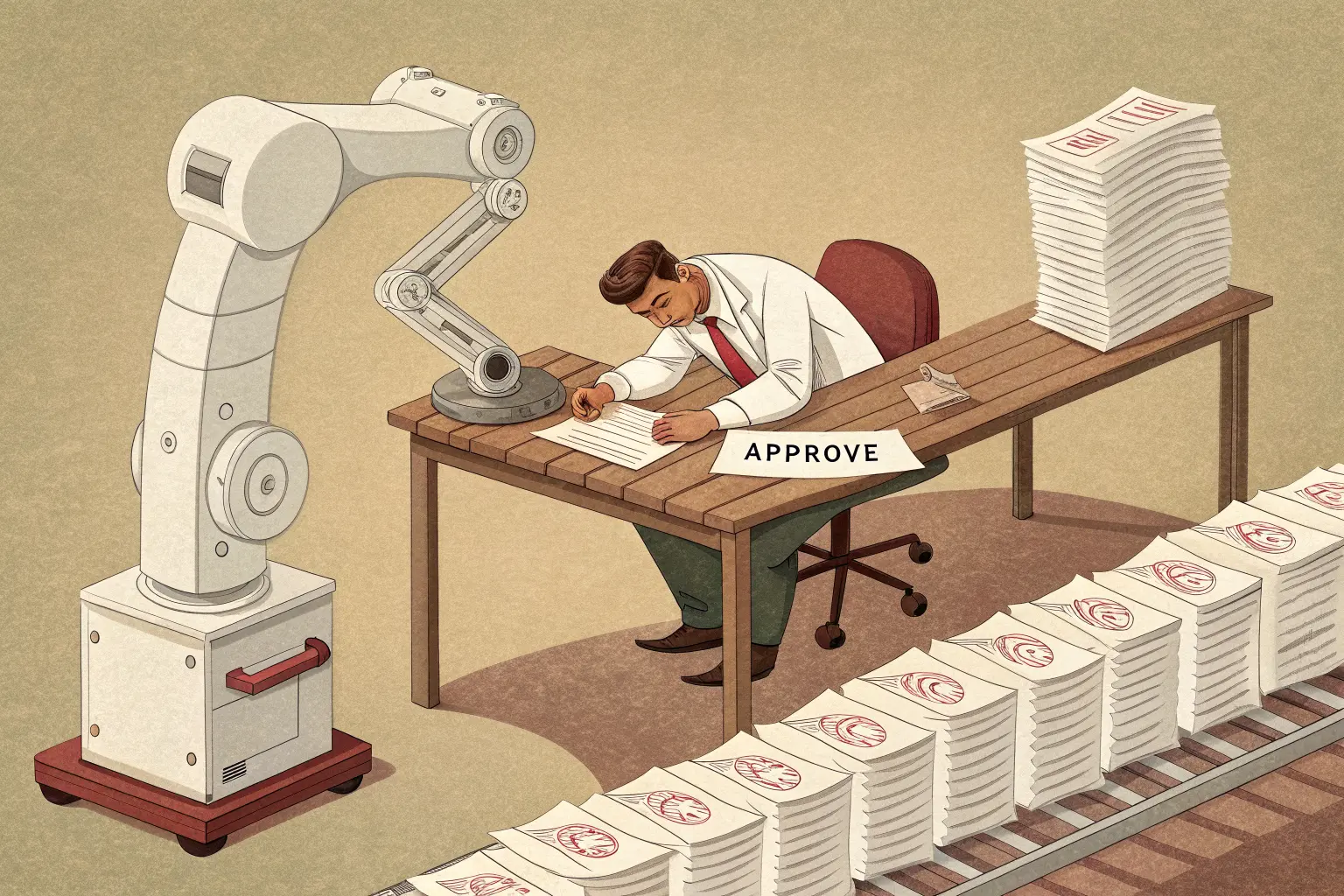
Every automation pitch has one phrase in it that does more work than the software does: "with a human in the loop." It gets said like a safety feature. The responsible box, ticked. It is not a safety feature. It is the sentence where the vendor quietly admits the thing does not run by itself, that the missing piece is you, and that you are not getting paid for the shift.
Here is how it actually ships. The vendor says the AI "handles" your quotes, or your follow-up emails, or your invoices. What the AI does is draft them. Then a human opens each draft, reads it, decides it is right, and clicks send. On the demo that step takes half a second, because the demo data is clean and the stakes are zero. In your business it takes all afternoon, because the thing going out has your name on it and a real customer on the other end.
The sales math only ever counts the typing. The automation writes a follow-up in two seconds that would have taken you three minutes, forty times a week, and the slide says you got six hours back. Nobody on that slide subtracts the reading. And reading a machine's work is not free. It is often slower than doing the work yourself, for a reason nobody warns you about.
Checking an answer you didn't reason your way to is harder than finding it yourself.
When you write the quote, you know it is right because you built it. You held the numbers. When the machine writes it, you have to reconstruct the reasoning it never showed you, from the outside, under time pressure, to decide whether to trust it. That is not a glance. That is the real work, done backwards. The automation did not remove the thinking. It moved the thinking from your hands to your eyes and made it harder.
And you cannot skip it, because the machine is confidently wrong at some rate. Call it one in twenty. The problem is not the rate, it is that the wrong one looks exactly like the nineteen right ones. There is no red flag on the bad quote. It is formatted perfectly, it reads fine, the number is just off by a digit. So you cannot skim. Either you read all twenty like you mean it, or you sign your name to the one you did not catch.
Here is the trap that actually gets people. The nineteen good ones train you. By week three it has been right every time you looked, so you start trusting it, clicking through faster, reading less. That is not laziness, it is how attention works. Humans are genuinely bad at staying alert to a thing that is reliable ninety-five percent of the time. The vigilance decays right up until the day the twentieth one goes out to your best account with the wrong price on it, and "the AI generated it" is not a sentence that gets you paid.
I have built one of these. A drafting automation for a client who sends a lot of the same kind of message over and over. Clean build, worked well, saved real time on paper. And the owner still opened every single draft before it went out. Not because the tool was broken. Because one wrong message to the wrong person cost more than the time saved on a hundred right ones, and he knew that in his gut even when the dashboard told him to relax. The automation was real. The hours-saved number was fiction, because it counted the writing and ignored the reading, and the reading had quietly become a job.
So here is the one question that cuts through every "automated" pitch. Does a human have to look at every output before it reaches a customer? If the answer is yes, you are not buying automation. You are buying a drafting assistant, and the price and the time-saved claim should both come down to match. A drafting assistant is a perfectly good thing to own. It is just a different, cheaper thing than the one on the slide.
Then ask the follow-up they will like less. Can I tell a wrong output from a right one at a glance? If the errors are visible, like a blank field or a dead link, review is fast and the savings are real. If the errors are invisible, like a plausible wrong number, review is all or nothing and most of your savings just evaporated. The entire value of the thing lives in that answer, and no demo will volunteer it.
I sell this stuff, so take this as a warning from inside the tent. The automation I will put my name on is the narrow, boring kind where a mistake is cheap and obvious, so you really can stop reading every one. Sorting. Tagging. Routing. The follow-up that just needs to exist, not be perfect. Everything past that, where a quiet wrong answer can reach a customer, I will build you the draft step and tell you to your face that you are still in the loop, because you are. Pretending otherwise is how you end up paying me to generate your mistakes faster.
The loop is not a flaw in the product. For most of what is being sold, the loop is the product. You are just the part they left off the invoice.