Your Support Chatbot Is Built to Make You Give Up
The industry has a metric for the customer who quits. It's called deflection, and every ticket you abandon counts as a win.
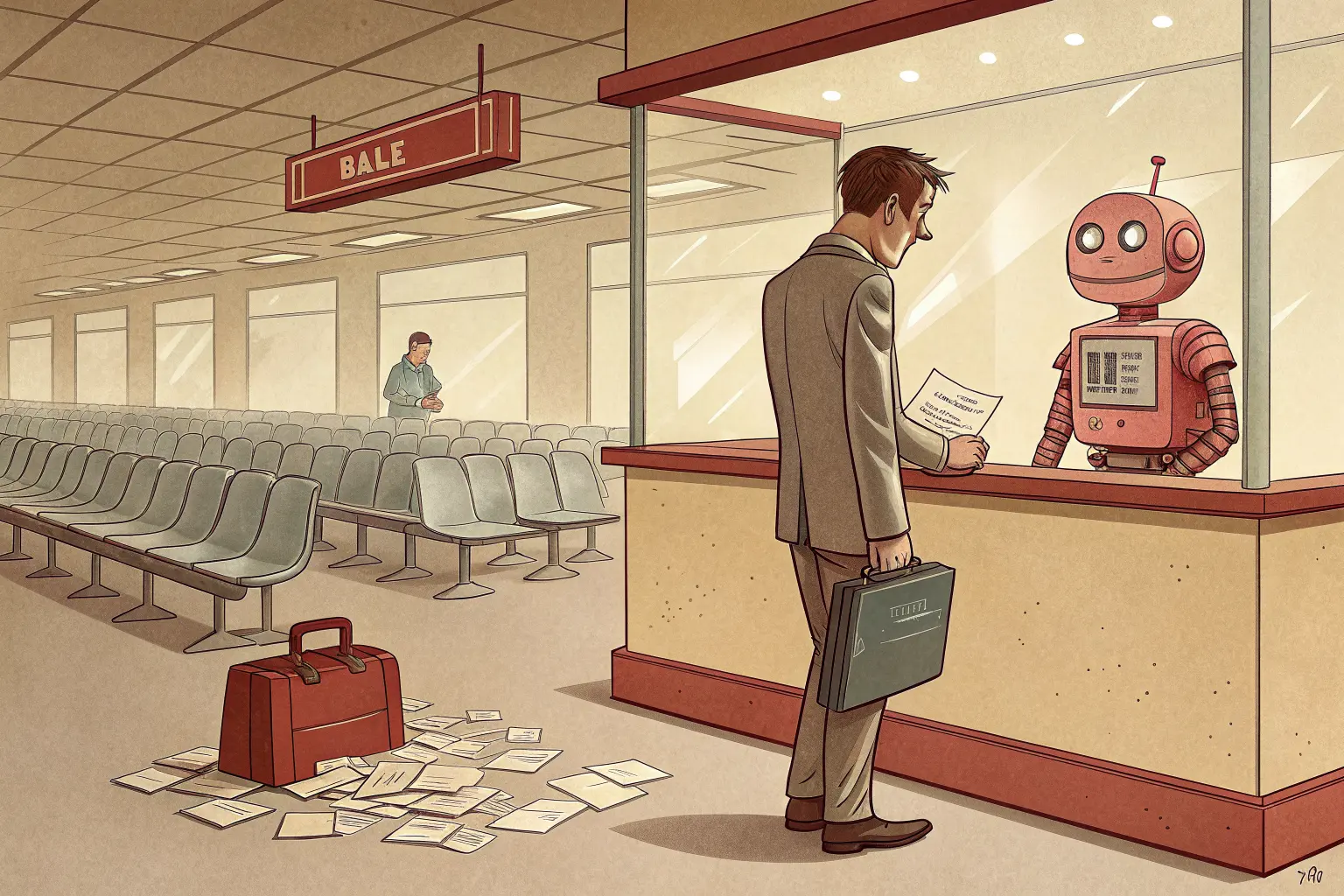
Every company that dropped a chatbot between you and a human told you it was there to help. Faster answers. Available at 3am. "We value your time." But they measure this stuff, and the number they actually stare at on the quarterly slide has a name that gives the whole game away. Deflection. Every question the bot handles without handing you to a person counts as a deflected ticket. A support org does not celebrate a problem solved. It celebrates a customer who stopped trying.
Sit with that word for a second. To deflect is to turn something away. In this system, you are the thing being turned away. The bot's job, the thing it is tuned and dashboarded and bonused against, is to get you to leave without an employee ever touching your case. When you finally sigh and close the tab, that outcome scores as a success. You didn't get helped. You got deflected, and somewhere a metric just turned green.
The bot isn't failing to help you. Making you stop asking is the help it was built to deliver.
Here's the part that will never make it onto the pricing page. There are two ways to hit a deflection target. You can answer the question, which is hard, or you can wear down the person asking, which is easy. Guess which one the software is better at. The endless "Did that answer your question?" loops. The confident rephrasing of the FAQ you already read. The "I'm still learning" apology on turn six. The path to a human buried three menus deep behind "Are you sure you don't want to try our help center first?" None of that is a bug. That is the product doing its job on you.
I've watched it get worse in real time. Five years ago the support bot was a dumb decision tree and everyone knew it, so companies at least left an obvious "talk to an agent" button sitting right there. Then the language models got good enough to sound helpful, and that was the trap. A bot that sounds helpful can string you along for fifteen minutes before you realize it has no ability to do the one thing you actually need. The model got better. Your outcome did not. What improved was the company's power to keep you talking to nobody.
The math is simple and it is not on your side. A live support contact runs a company somewhere between five and twenty dollars depending on the industry. A bot conversation costs pennies. Push deflection from 40 percent to 70 percent and that is not a better experience for anybody. That is a payroll line getting cut, and the chatbot vendor pitches it to the executive in exactly those terms. The slide says "deflection." The slide does not say "we found a way to make frustrated customers surrender before they reach an employee." Same thing. Nicer word.
It works because you're outnumbered. You have one problem and a finite amount of patience. The company has a bot with infinite patience and a scoreboard that rewards it for outlasting you. That asymmetry is the entire design. They aren't trying to win the argument. They're trying to make you walk out of the room.
Want the proof? Watch what happens the moment you type "cancel." A human materializes. Every company that swears it cannot possibly staff live support suddenly finds a warm body the instant your money is on the line. The support was never impossible to provide. It was rationed, held back for the exact moment you stopped being a cost and became lost revenue. Retention gets a person. Your broken order gets a bot that says "I completely understand your frustration" and understands nothing.
So stop performing patience for a machine engineered to exploit it. Say "agent" on the first message and keep saying it. Mention canceling. Complain in public, because a post routes to a real human faster than a ticket ever will and the company knows it. None of that fixes the system. It just refuses to be the number that makes the system look like it's working.
The honest chatbot would open with a different line. Not "How can I help you today?" but "I'm here to lower the odds you ever reach someone who can." Nobody's shipping that. So next time a bot cheerfully asks whether it solved your problem, remember there's a dashboard somewhere counting on you to say yes and disappear. Don't give it the number.