AI Didn't Take Your Job. Your CEO Did.
"Automation" is the cleanest layoff press release ever written. It blames a machine for a decision a person made.
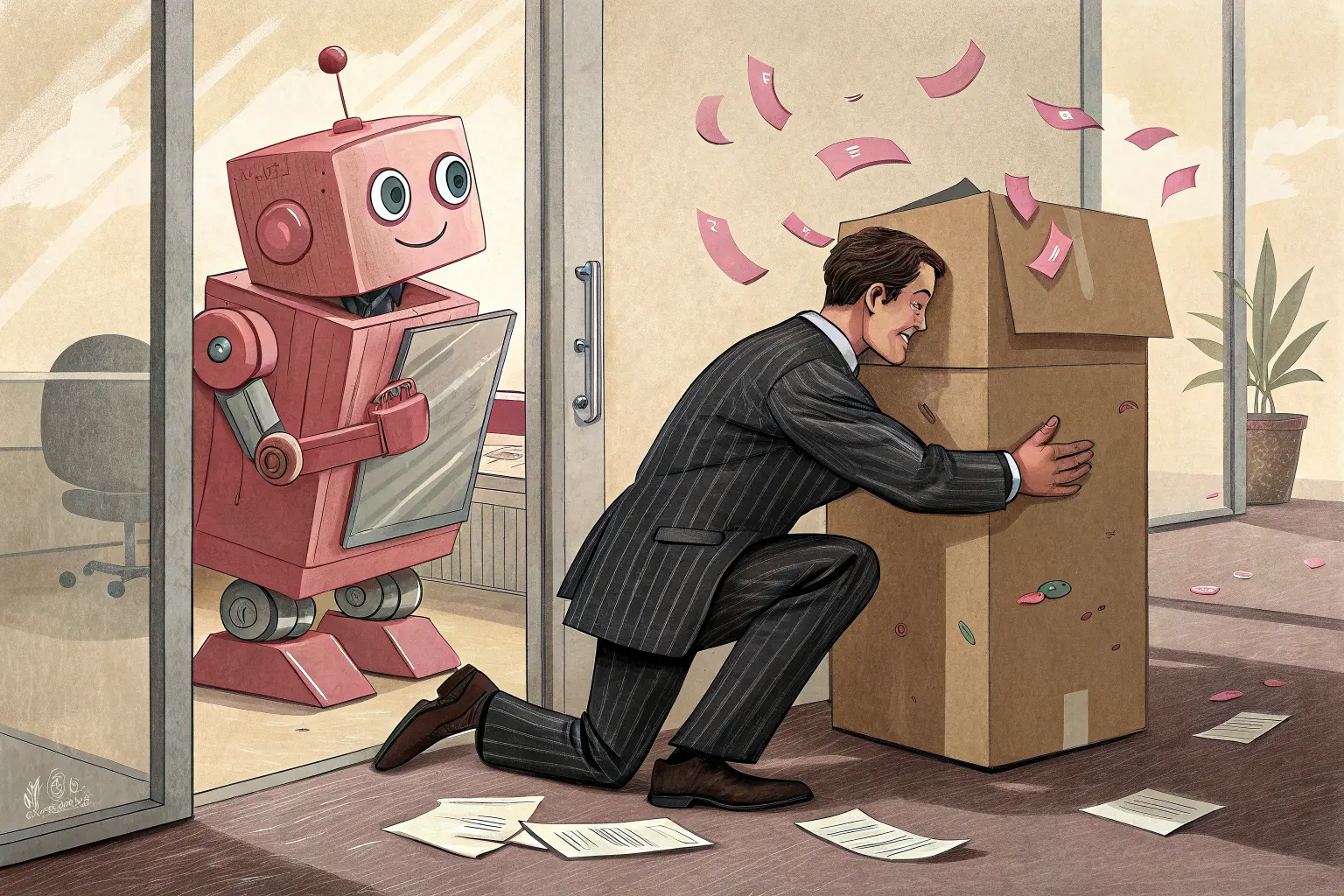
Read enough layoff announcements and you start to notice the word doing all the work. "Restructuring to focus on AI." Roles "made redundant by automation." A company sheds eight percent of its people, drops "AI" into the third paragraph, and the stock ticks up while the founder gets quoted sounding like a visionary instead of a guy who hired too fast. The people carrying a box to their car never get to read the real reason. The real reason is almost always older and more boring than a robot.
Blaming AI does two jobs at once, and that is exactly why it's so popular in the C-suite right now. It tells investors you're cutting costs, and it tells them you're cutting them for a forward-looking reason. Those are very different stories with the same severance check stapled to the back. "We over-hired during the cheap-money years and demand came in soft" makes you sound like you screwed up. "We're streamlining our org around AI" makes you sound like the future is happening inside your building. Nobody on an earnings call wants to be the first story. Everybody wants to be the second.
Here's the part the press release skips. Most of those cut roles weren't automated by anything. The work didn't vanish. It got shoved onto the people who survived the round, who now do their job and a chunk of someone else's for the same pay. That is not a machine replacing a human. That is a smaller team absorbing more load with a confident word attached so it photographs well. Call it automation if you want. The tickets, the deadlines, and the on-call rotations all still exist. They just have fewer hands.
The robot didn't fire you. It just took the blame, because it can't talk to a reporter.
Look at who comes out ahead of the story and you understand why it keeps getting told. The CEO looks decisive and modern. The board gets cover for a cost cut they wanted anyway. The AI vendors get a logo for their case-study slide. The business press gets a clean, frictionless headline that writes itself. Everybody above a certain pay grade benefits from the version where a machine did it. The only person who eats the lie is the one who now has to sit across from the next hiring manager and explain, with a straight face, why their entire team got "automated."
None of this means AI does nothing. It means the timeline doesn't match the marketing. The models are genuinely good at narrow, well-defined tasks, and they are nowhere close to running a department, closing the books, or owning a customer. The jobs getting cut in 2024 and 2025 are mostly the same jobs that got over-hired in 2021 and 2022, when money was free and every company decided it was a hypergrowth company. The bill on that came due. "AI" just walked through the door at the perfect moment to take the rap for it.
You can spot the difference if you know the tell. When a role is actually automated, the work disappears with it. Nobody picks up the slack because there's no slack to pick up. So watch what happens in the months after one of these "AI-driven" reductions. Do the deliverables stop, or do they get redistributed across exhausted survivors? Does the queue empty, or does it just move? Real automation removes work from the world. Most of what's marketed as automation right now removes people from payroll and leaves the work sitting exactly where it was.
And the lie has a cost beyond the people it burns, which is the thing that actually bothers me. There is a real automation story coming. Some of it is already here. We are going to need an honest, hard conversation about which jobs change, who captures the gains, and who gets left holding nothing. We can't have that conversation if every executive cries robot every time they trim the org chart to juice a quarter. Cheapen the word now and you spend the credibility we'll need when the displacement is real and the person across the table genuinely did get replaced by a system that does their old job better.
So if you got walked out and they told you it was AI, you're allowed to be skeptical. A spreadsheet decided your salary was a line item that looked good shrinking. A person read that spreadsheet and clicked the button. The machine in the story is a prop. It got cast as the villain because it doesn't have a severance negotiation, doesn't file for unemployment, and never, ever talks to the press.